Designing the Board: A Systems Thinker's Guide to Chess, War, Power, and the Lives We Make Possible
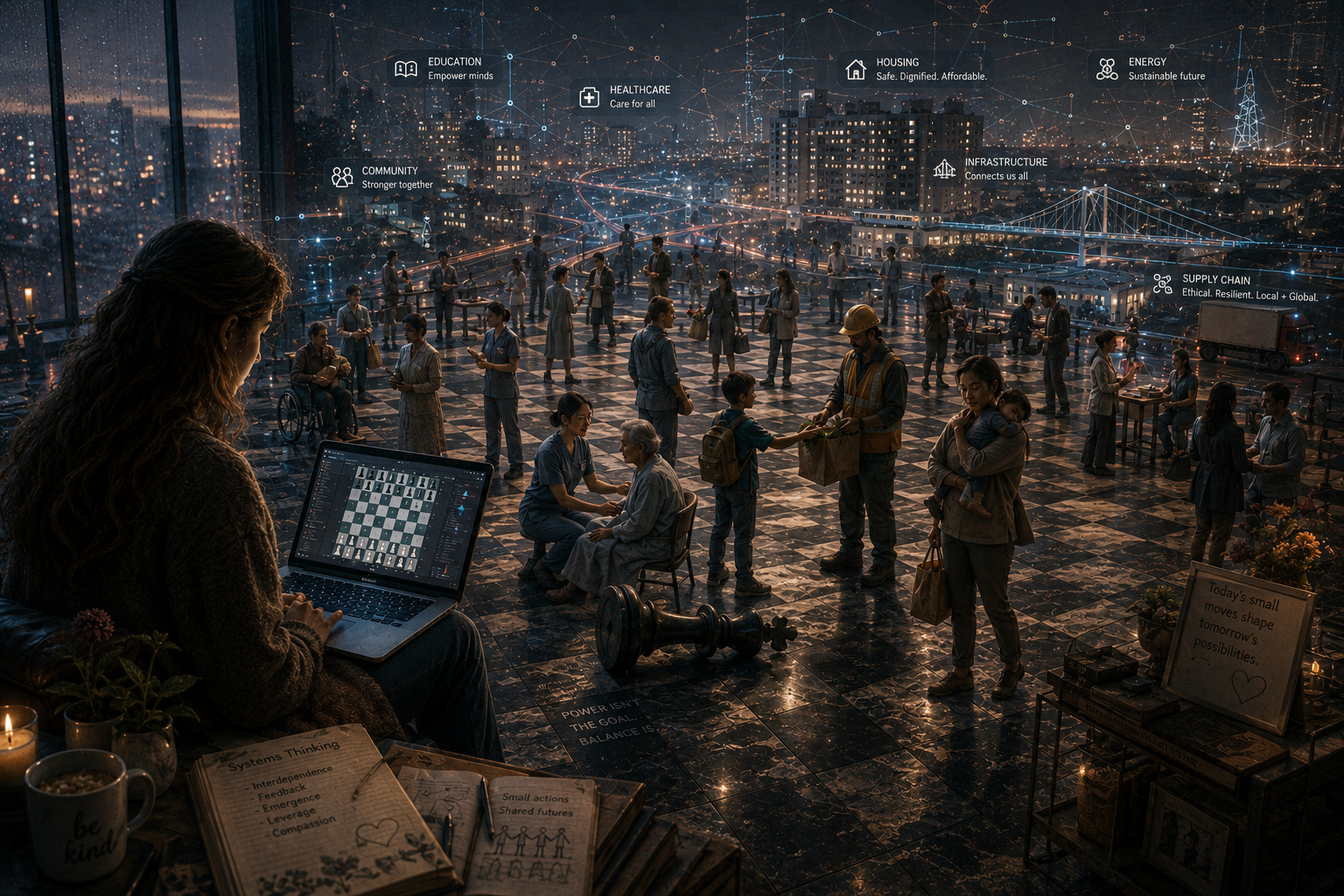
There’s a particular kind of beginner chess player who becomes obsessed with clearing the board.
Every exposed pawn feels irresistible. Every hanging bishop demands attention. The temptation is not merely to win, but to tidy reality itself. Remove every threat. Eliminate every loose end. Leave nothing standing.
But chess has no bonus points for total destruction.
I was eating oatmeal and bullying cartoon chess pieces on Duolingo when it finally occurred to me that I had misunderstood the entire game.
What if pawns are not abstractions?
What if they are farmers, teachers, engineers, nurses, students, exhausted parents trying to make rent, people walking dogs in the rain?
Then “capturing pieces” starts feeling different.
A great deal of human history has been built around the logic of capturing pieces. Wars escalate beyond their original aims. Political movements become purity contests. Institutions expand until they begin consuming the very populations they were meant to protect. Entire economic systems reward extraction long after basic survival has already been secured.
The board disappears beneath the appetite to dominate it.
Ancient strategists understood the danger of this long before modern societies did: the most effective victories are often the least destructive ones.
Sun Tzu’s famous line, “The supreme art of war is to subdue the enemy without fighting,” sounds almost paradoxical at first. But it reflects a deeper understanding of systems. Real strategy is not endless force. It is positioning. Pressure. Incentives. Structure. Creating conditions where collapse becomes inevitable before catastrophe becomes necessary.
The strongest move is not always the loudest one.
Sometimes power looks more like quiet architecture.
A healthy bridge prevents disaster without ever receiving applause for the disasters that never occurred. A stable society distributes pressure before it becomes violence. A well-designed institution limits the damage any single personality can inflict.
Outcomes are shaped more by system design than most of us like to admit.
“How do we stop bad people from doing harm?” may ultimately be less useful than asking, “How do we build systems that make harm harder to scale?”
That idea keeps resurfacing everywhere.
Psychologists have identified personality clusters associated with harmful leadership: narcissism, Machiavellianism, psychopathy. Traits capable of producing charisma without empathy. Confidence without conscience. Strategic brilliance detached from human cost.
The uncomfortable thing is that many of these same traits are often rewarded socially and politically. Sometimes the very qualities that help someone rise are the qualities that later make them dangerous.
Which raises a difficult question: should societies try to identify these tendencies early?
History has not been especially reassuring on that front.
Trying to perfectly screen the players matters less than designing healthier systems around them.
Checks and balances.
Distributed power.
Strong institutions.
Community cohesion.
Transparent systems.
Conditions where no single personality can dominate unchecked.
Human beings emerge from environments, not vacuums. Stability matters. Attachment matters. Chronic stress matters. Neglect matters. Communities shape nervous systems long before those nervous systems participate in politics, corporations, armies, or economies.
Yet modern societies often discuss children primarily at the moment of birth rather than throughout the long ecosystem required to help a human being flourish afterward.
That absence feels important.
A civilization willing to debate the morality of life while ignoring the conditions that make life psychologically survivable begins to resemble a gardener passionately arguing about seeds while neglecting soil, water, climate, and light.
The consequences eventually emerge anyway.
In rising loneliness.
In distrust.
In burnout.
In addiction.
In rage looking for a target.
In fluorescent grocery aisles filled with exhausted people staring blankly at shrinking paychecks and glowing phones.
In populations increasingly drained by systems that extract more energy than they return.
Debates around reproductive rights often become locked inside philosophical questions about personhood or autonomy while skipping over the systems question sitting quietly underneath everything:
What conditions are we creating for human development?
We are already struggling to care well for many wanted children. That reality matters. Not because unwanted people lack value, but because human flourishing requires more than simply arriving alive.
Resources matter.
Feeling genuinely wanted matters.
Attachment matters.
Enough support that children are not entering existence already submerged in panic, neglect, exhaustion, resentment, or instability.
Enough collective investment that parents are not carrying impossible burdens entirely alone.
Enough foresight to understand that the conditions surrounding a life shape not only individual outcomes, but the emotional texture of civilization itself.
Sometimes I wonder how differently society would think about bodily autonomy if men carried pregnancies. It is difficult to imagine we would not already have radically advanced reproductive technologies, expansive support systems, and more nuanced public conversations around consent, risk, responsibility, and care.
Necessity tends to accelerate invention when power personally experiences the consequences.
Even artificial intelligence begins to look different through this lens.
Most conflicts throughout history have depended on asymmetry. Someone knew something another side did not. A hidden route. A delayed message. A bluff. An intercepted signal.
But machine intelligence increasingly compresses those asymmetries.
One possibility is acceleration.
Faster prediction. Faster reaction. Faster escalation.
An arms race measured in milliseconds instead of miles.
But another possibility is stranger.
High-level chess engines playing one another often drift toward draws, not because the game lacks complexity, but because both sides can see too much. Aggression becomes harder to sustain when every vulnerability is immediately legible.
The only winning move is not to play.
A game stops being about intelligence once everyone can see the ending.
Perhaps that is one future AI accidentally nudges civilization toward: not wisdom exactly, but enforced recognition of mutual fragility.
The realization that some games stop being worth playing once the cost becomes universally visible.
Civilizations reveal themselves through what they optimize for.
Some optimize for conquest.
Some for extraction.
Some for spectacle.
Some for short-term advantage at long-term cost.
And some, occasionally, begin asking a more difficult question:
What would it mean to design the board intelligently in the first place?
That’s where the leverage is.
Not in perfectly screening every player, but in designing systems resilient enough to survive flawed human beings.
A society that supports children rather than merely demanding they be born.
A civilization capable of welcoming people well.
The goal becomes something quieter and perhaps more difficult than victory:
how do we keep the game going sustainably?